


How to File a Commercial Property Claim in Florida
Table of Contents
- What to Do in the First 24 Hours After Property Damage
- Documentation for Business Property Damage: What Insurers Expect
- How to File a Commercial Property Claim in Florida: Step by Step
- The Florida Commercial Property Insurance Claim Timeline
- Hiring a Public Adjuster for Commercial Claims
- Business Interruption Claims and Bad Faith Protections
- Negotiating a Commercial Property Claim Settlement in Florida
- Frequently Asked Questions
Last Updated: September 29, 2026
What to Do in the First 24 Hours After Property Damage
The first day after damage decides how your commercial property claim will go. Move fast, and you protect both your building and your right to recover. According to FEMA’s business disaster guidance, businesses that document damage immediately recover faster than those that wait.
Secure the Property and Prevent Further Loss
Your policy requires you to limit damage after a loss. This duty is called mitigation of damages, and skipping it can shrink your payout or void part of your claim.
Do these things right away:
- Board up broken windows and doors
- Tarp roofs and cover exposed inventory
- Shut off water, gas, or power where needed
- Move undamaged stock to a dry, locked space
- Keep every receipt for emergency work
Report the Incident and Start Your Paper Trail
Call your insurer and your broker the same day. Then write everything down.
Start a simple claim log with:
- Date and time of the loss
- What caused it (storm, fire, burst pipe, theft)
- Who you spoke to at the insurer
- A claim number, once issued
Documentation for Business Property Damage: What Insurers Expect
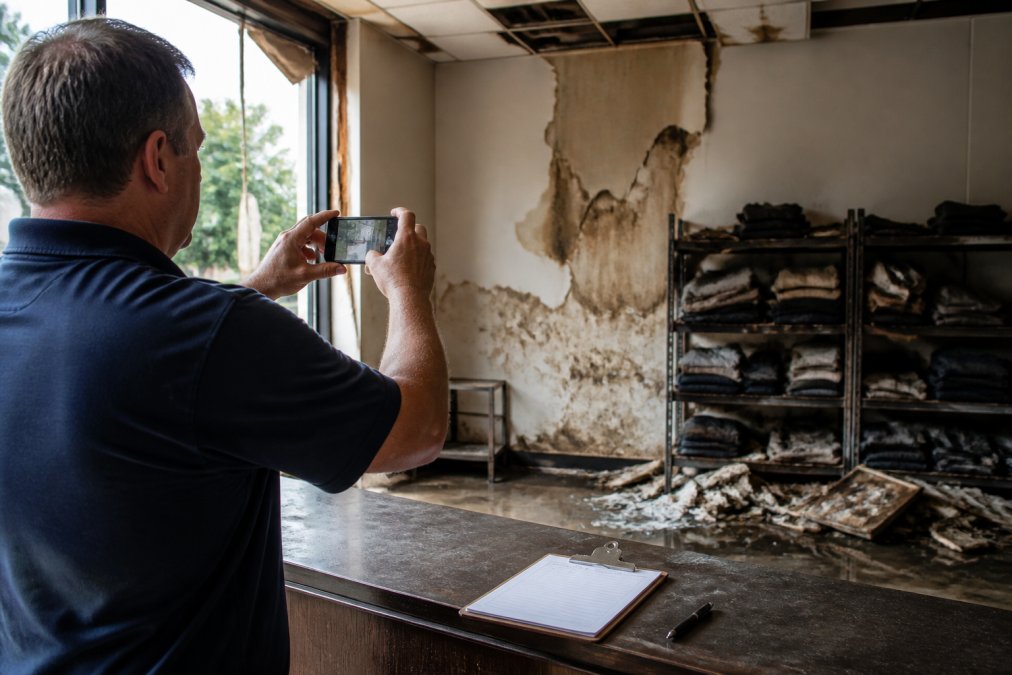
Documentation is where most commercial property claims are won or lost. Insurers want proof of what you owned, what it was worth, and what it cost to replace.
Photographic Evidence and Asset Inventories
Shoot wide, then shoot close. Wide photos show the room. Close photos show the damage.
Your photo set should include:
- Every damaged area, before you touch anything
- Serial numbers on equipment
- Water lines on walls and stock
- The cause, if visible (fallen tree, cracked pipe)
Walk the whole property on video, narrating what you see. A five-minute walkthrough often proves more than fifty still photos, and it timestamps everything in one file.
Proof of Loss and Supporting Records
A proof of loss is a sworn statement listing what you’re claiming and why. Most policies require it, and it must be accurate.
Attach supporting records:
- Repair estimates from licensed contractors
- Receipts for emergency mitigation
- Payroll records, if you’re claiming lost income
- Lease or mortgage documents
Sign nothing until the numbers match your evidence.
How to File a Commercial Property Claim in Florida: Step by Step
Filing a commercial property claim in Florida follows a clear sequence. Here’s the full process, start to finish.
- Report the loss to your insurer and broker, usually within days of the damage.
- Mitigate further damage and keep all receipts.
- Document everything with photos, video, and a written inventory.
- Get repair estimates from at least two licensed contractors.
- Submit your proof of loss with all supporting records attached.
- Meet the adjuster on site and walk the damage together.
- Review the settlement offer against your own estimates.
- Negotiate or dispute if the offer falls short.
Never start permanent repairs before the adjuster inspects. Doing so can turn a covered loss into a denied one, because the insurer can no longer verify the damage.
The Florida Commercial Property Insurance Claim Timeline
A commercial property insurance claim timeline runs from the day of loss to final payment. Most claims move through reporting, inspection, proof of loss, and settlement. What separates a well-managed claim from a contested one is knowing which deadlines are set by your policy and which are set by state law, because missing either can cost you the claim.
Here’s the working timeline most commercial claims follow:
| Stage | What Happens | Typical Timing |
|---|---|---|
| Report the loss | Notify insurer and broker | Same day to a few days |
| Adjuster inspection | On-site damage review | Within days to weeks |
| Proof of loss | Sworn claim statement filed | Often within 60 days of request |
| Settlement offer | Insurer responds | Weeks to months |
| Payment | Funds released | After agreement |
Notice of Claim: The Deadline That Lives in Your Policy
The first deadline is not in a statute, it’s in your policy’s notice provision. Commercial property policies typically require prompt notice of a loss, and many specify a hard window (commonly 30 to 90 days) for reporting. Courts have enforced those provisions, so the practical rule is: report the loss the day you discover it, in writing, and keep proof you did.
The Statute of Limitations on Suing Your Insurer
If negotiations break down and you have to sue, state law, not your policy, sets the clock. Under Florida law, the two windows that matter most for commercial property claims are:
- Breach of contract: a 5-year statute of limitations for a written contract, which is the category most property policies fall into.
- Bad faith: a 2-year statute of limitations running from the date the cause of action accrues (generally when the insurer’s liability is established), added by the legislature in 2022 and applied to claims arising after that date.
Do not wait until the insurer’s internal appeal process is exhausted to talk to a lawyer. The statute of limitations runs while you negotiate. A short consultation early costs far less than a barred claim.
The 60-Day Claim-Payment Rule
Florida law also imposes a 60-day deadline on the insurer: after receiving a proof of loss, the carrier must pay or deny the claim within 60 days, unless the failure is caused by factors outside its control. That rule gives you a lever. If 60 days pass with no written position, document the silence, it becomes evidence if the claim later turns into a bad-faith dispute.
What Slows a Claim Down
The most common delays are self-inflicted: late notice, an incomplete proof of loss, missing receipts, or repairs started before the adjuster inspects. The second-most-common cause is external: a catastrophe that overwhelms the adjuster pool. You cannot control the second. You can control the first, and doing so is the difference between a claim paid in weeks and one litigated for years.
Hiring a Public Adjuster for Commercial Claims
A public adjuster works for you, not the insurer. They review your loss, build the claim, and negotiate on your behalf. In Florida, public adjusting is a licensed profession regulated by the Department of Financial Services, and the rules that govern the relationship are specific enough that you should know them before you sign anything.
When a Public Adjuster Earns Their Fee
Hiring a public adjuster for commercial claims makes sense when:
- The loss is large or complex (think a warehouse fire, a multi-tenant water loss, or a hurricane claim with disputed scope)
- Your insurer’s offer looks low against your contractor estimates
- You lack the time or staff to manage the claim
- Business interruption losses are involved and you need help quantifying them
- The insurer has invoked an appraisal or examination-under-oath process
Florida Licensing and Fee Rules You Should Know
Florida regulates public adjusters through the Department of Financial Services. A few rules matter before you sign:
- Licensing. A public adjuster must hold a current Florida license (or be a licensed public adjuster apprentice working under a supervising adjuster). You can verify any license through the state’s licensee search before you engage anyone.
- Fee cap. For claims arising from a declared state of emergency, Florida caps the public adjuster’s fee at 10% of the settlement (Public Adjusters | Consumer Services). For non-emergency claims, the fee is negotiable but must be disclosed in writing.
- Contract requirements. The contract must be in writing, must state the fee, and must be signed by the policyholder. The adjuster cannot solicit you at the scene of a loss during the first 48 hours after a declared emergency.
- Rescission window. You generally have the right to cancel the public adjuster contract within a set window after signing (commonly three business days), and the adjuster must disclose that right.
- No fee on undisputed amounts you already recovered. The adjuster’s fee applies to the amount they help recover, not to money the insurer already agreed to pay before the adjuster was involved.
Ask any public adjuster you interview for their Florida license number, a sample contract, and a written explanation of how their fee is calculated on a claim like yours. A legitimate adjuster will hand all three over without hesitation.
Public Adjuster vs. Independent Adjuster vs. Your Own Staff
It helps to keep three roles straight:
- Company (staff) adjuster: employed by the insurer. Their job is to evaluate the claim for the carrier.
- Independent adjuster: a contractor hired by the insurer to handle overflow, especially after a catastrophe. They still work for the carrier.
- Public adjuster: hired by you, paid by you, and obligated to represent your interests.
A fourth option is to handle the claim in-house with your broker’s help. That works for straightforward losses. It stops working when the claim involves disputed scope, business interruption math, or an insurer that has already signaled it intends to fight.
A public adjuster is not required for every claim, and no one can force you to hire one. But for a large or contested commercial loss, the licensing, fee, and contract rules above are the difference between a professional advocate and an expensive mistake. Verify the license, read the contract, and confirm the fee in writing before you sign.
Business Interruption Claims and Bad Faith Protections
Business interruption coverage replaces lost income when damage forces you to close. It also covers ongoing costs like rent and payroll while you rebuild.
To claim it, show:
- Your income before the loss
- How long you were closed
- Extra costs you paid to keep operating
Negotiating a Commercial Property Claim Settlement in Florida
Most first offers are not final offers. Treat the settlement as a starting point, not a verdict.
To negotiate well:
- Compare the offer to your contractor estimates
- Point to specific missed items, line by line
- Ask for the insurer’s calculation in writing
- Request the appraisal process if you and the insurer disagree on value
Never accept a settlement on the phone. Ask for it in writing, read it against your proof of loss, and take a day before responding. Pressure to sign fast usually means the offer is low.
Frequently Asked Questions
What should you avoid saying to your insurance company when filing a commercial property claim?
Never speculate about the cause of damage, admit fault, or offer opinions on what you think is covered. Avoid phrases like ‘I think it was our fault’ or ‘it’s probably not that bad.’ Stick to facts: what happened, when, and what damage you observed. Also avoid giving a recorded statement before you have documented everything and reviewed your policy. Anything you say can be used to adjust or deny your commercial property claim.
How long does an insurance company have to acknowledge and pay a claim in Florida?
Under Florida law, insurers must acknowledge receipt of a claim within 14 days. They then have 90 days to approve or deny the claim after receiving proof of loss, though this can extend if more investigation is needed. Payment is due within 20 days after settlement agreement. These deadlines matter for your Florida commercial property insurance claim timeline, so track every date and follow up in writing if the insurer misses a window.
What documentation is required to support a commercial property damage claim?
You will need photographs and video of all damage, a detailed inventory of damaged or destroyed assets with purchase receipts or valuations, police or fire department reports where applicable, contractor estimates for repairs, and a sworn proof of loss statement. For business interruption claims, include income statements, tax returns, and records showing lost revenue. Thorough documentation for business property damage speeds up the review and reduces the chance of a coverage dispute.
Do I need to hire a public adjuster for my commercial claim?
It depends on claim size and complexity. Hiring a public adjuster for commercial claims makes sense when damage is extensive, the insurer’s offer seems low, or you face a coverage dispute. Public adjusters work for you, not the insurer, and typically charge a percentage of the settlement. For straightforward claims under a few thousand dollars, you can likely handle it yourself. For catastrophic loss or business interruption claims, professional representation often pays for itself.
Filing a commercial property claim in Florida is manageable when you document early and follow the process. The challenge is having a team in your corner when the adjuster calls. Galt Insurance builds tailored policies for Florida business owners, manages your whole insurance profile in one place, and gives you a dedicated team that advocates for you at claim time. Get started with Galt Insurance and recover faster after a setback.