


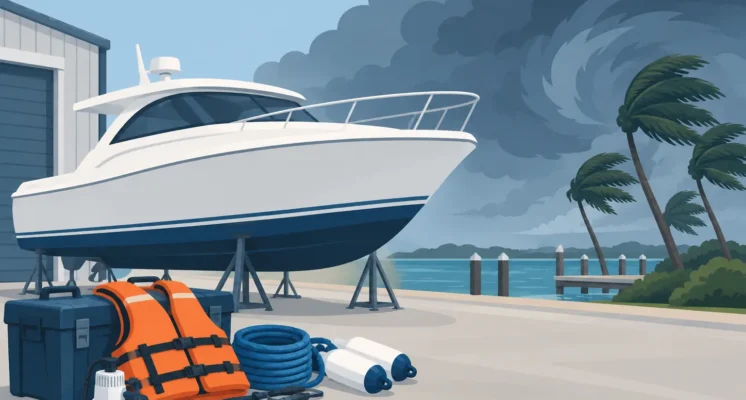
How to Prepare Your Boat for Hurricane Season
A named storm is not the time to decide whether your boat belongs in a marina, on a lift, on a trailer, or in a boatyard. By then, haul-out lists may be full, waterways may be restricted, and every decision costs more time than it should. To prepare your boat for hurricane season, make the plan while Southwest Florida is calm, your service providers are available, and your insurance documents are easy to review.
For boat owners, hurricane preparation is about more than protecting an investment. It protects family time on the water, reduces potential damage to neighboring vessels and docks, and gives you a clearer path forward if a storm does affect your property. The right approach depends on your boat, its location, your marina agreement, and the terms of your policy.
Start With a Written Hurricane Plan
A hurricane plan should answer one question before a storm is in the forecast: what, exactly, will happen to your boat? Write down the location where it will be secured or stored, who is authorized to move it, and the point at which you will act. Do not rely on memory or a group text started the night before landfall.
Your plan should include your marina or boatyard contact, a trusted captain or marine service provider, and a family member who knows where the keys, registration, and insurance information are kept. Keep digital copies in secure cloud storage as well as a printed copy somewhere away from the boat.
It is also wise to understand your marina’s hurricane procedures in advance. Some facilities require vessels to leave when a named storm enters a certain forecast area. Others have designated storm slips, line requirements, or closure deadlines. A private dock has different considerations, including the condition of pilings, cleats, lifts, seawalls, and nearby vessels.
Decide Whether to Haul, Relocate, or Secure in Place
There is no single best answer for every boat. A trailerable center console stored inland has a very different hurricane plan than a large yacht kept in Naples Bay or a sailboat in a fixed marina slip. The goal is not simply to move the boat. It is to place it where it can be secured safely and realistically before demand surges.
Hauling Out Can Reduce Water Exposure
A professional haul-out and indoor or high-ground storage can be a strong option, particularly for smaller and mid-sized vessels. However, availability is limited, and outdoor storage still requires careful preparation. If your boat is stored on stands, ask the yard about its tie-down procedures, stand placement, and storm protocols.
If you keep a boat on a trailer at home, move it away from trees, power lines, and areas vulnerable to flooding. Lower the trailer, block the wheels, use properly rated ground anchors or tie-downs, and remove any loose equipment. A boat on a trailer can become a serious hazard if it shifts during high winds.
Securing in a Slip Requires More Than Extra Line
If your boat will remain in the water, inspect every line, cleat, chock, piling, and fender before hurricane season begins. Use appropriately sized storm lines with chafe protection at contact points. Lines should allow for expected storm surge while limiting excessive movement, which is where the advice of your marina manager, captain, or qualified marine professional matters.
Do not assume more lines automatically mean better protection. Poorly arranged lines can chafe through, overload a fitting, or restrict a vessel as water levels rise. Consider the surrounding boats as well. A carefully secured vessel can still be damaged by another boat that breaks free.
Boats on lifts deserve their own review. A lift may help in certain conditions, but it is not a universal hurricane solution. Capacity, wind exposure, surge, vessel size, and the integrity of the dock structure all matter. Follow the lift manufacturer’s guidance and your marina or dock professional’s recommendations rather than relying on a one-size-fits-all rule.
Remove Wind Catchers and Seal the Boat
Wind finds anything that is loose. Before a storm, remove canvas enclosures, bimini tops, sails, antennas that can be safely removed, deck chairs, cushions, coolers, fishing gear, electronics, and other portable items. Store them indoors whenever possible. Folding a canvas cover down and hoping it holds is often not enough in hurricane-force wind.
Close and secure hatches, ports, cabin doors, lockers, and vents according to the manufacturer’s guidance. Check cockpit drains and scuppers so rainwater has a clear path out. A blocked drain can turn a heavy rain event into a flooding problem, even if the hull itself remains intact.
Review your batteries, bilge pumps, and automatic float switches well before storm season. Pumps should be operational, batteries charged, and backup power considered where appropriate. Keep in mind that a pump is not a substitute for sound mooring or proper storage. It is one part of a larger plan.
Document the Boat Before the Forecast Changes
A thorough photo and video record can make a difficult situation easier after a storm. On a clear day, photograph the hull, deck, cabin, engine area, electronics, trailer, tender, and any recent upgrades. Capture the vessel identification number, registration, serial numbers, and the condition of major equipment.
Include wide shots showing where the boat is normally kept and close-ups of existing scratches or wear. Save receipts for upgrades, maintenance, electronics, and custom equipment. Documentation cannot prevent damage, but it can help establish the boat’s pre-storm condition if you need to report a claim.
Do not wait until a hurricane warning to take these photos. A rushed record made in poor light, with the boat already covered or moved, is less useful than a well-organized file created at the beginning of the season.
Review Boat Insurance Before You Need It
Your boat policy should be part of your hurricane plan, not a document you look for after damage occurs. Review the agreed value or actual cash value basis, deductibles, navigation territory, lay-up provisions, equipment limits, towing coverage, and any requirements that apply to named storms. Hurricane or named-storm deductibles may differ from the deductible you expect for another type of loss.
Pay attention to the details that reflect how you actually use the boat. A vessel that has been upgraded, moved to a new marina, kept at a second home, or taken farther offshore may need a policy review. The same is true if you have added a tender, higher-value electronics, fishing equipment, or a new trailer.
It is also helpful to know your insurer’s claim-reporting process before an event. Keep policy numbers and your agent’s contact information accessible. After a storm, safety comes first. When conditions allow, document damage, take reasonable steps to prevent further loss if it is safe to do so, and report the claim promptly.
At Galt Insurance, those conversations are part of protecting what matters most. A dedicated team can help you review how your boat coverage fits alongside your home, flood, excess liability, and other coastal insurance needs, especially when your property or lifestyle changes.
Make the Plan Early Enough to Use It
The most effective hurricane plan has deadlines. Choose a pre-season date to inspect equipment and update documentation. Set a separate trigger for confirming haul-out availability or checking your storm-slip arrangement. When a system enters the forecast, follow the plan early rather than waiting for certainty. By the time a storm’s exact track is clear, the practical options may already be gone.
Hurricane season asks boat owners to make decisions under pressure. A plan made early gives you something better than last-minute optimism: a clear, responsible way to protect the boat, the people around it, and the time on the water you look forward to when the skies clear.