


Insurance Insights
Perspectives on protecting your home, business and everything you value.
Can Your Landscaping Business Survive a Vehicle Liability Lawsuit?
Last Updated: October 26, 2026
Quick Summary
Protecting your landscaping business from vehicle liability starts with commercial auto insurance covering your trucks, trailers, and towed equipment, plus hired and non-owned auto coverage for employees driving rentals or personal vehicles. Add annual driver screening, signed pre-shift safety checklists, and an umbrella policy above your auto limits.
- A personal auto policy will not reliably cover a truck loaded with commercial equipment or a trailer hauling a mower.
- Hired and non-owned coverage handles liability when employees drive rented trucks or personal vehicles for business.
- Re-check driver licenses and records annually, not just at hire, and keep results in the personnel file.
- Keep roughly 10 to 15 percent of loaded trailer weight on the tongue to prevent sway and fishtailing.
- Do not repair the truck, trailer, or equipment until your insurer has inspected it or authorized repairs.
Table of Contents
- Why Vehicle Liability Lawsuits Threaten Landscaping Businesses
- Commercial Auto Insurance for Landscaping Businesses
- Hired and Non-Owned Auto Insurance for Landscapers
- Employee Driver Screening for Landscaping Companies
- Landscaping Vehicle Safety Checklist
- What to Do After a Vehicle Accident: A Step-by-Step Response
- Coordinating Coverage: General Liability, Umbrella, and Exclusions
- Get a Vehicle Liability Review from Galt Insurance
- Frequently Asked Questions
Why Vehicle Liability Lawsuits Threaten Landscaping Businesses
A loaded truck and trailer rolling through a residential neighborhood is the single largest liability exposure most landscaping companies carry, and it rarely shows up on a balance sheet until a claim lands. Vehicle liability is the legal responsibility a landscaping business bears when its truck, trailer, or mower causes bodily injury or property damage to someone else.
The Real Cost of a Single Accident
One at-fault accident can trigger several claims at once: damage to the other vehicle, medical costs for the people inside it, damage to a customer’s lawn or driveway, and lost income while your truck sits in the shop. A one-truck, two-person crew can be shut down for a week by a single collision. The real exposure is not the repair bill but the lawsuit that follows serious injuries.
Commercial Auto Insurance for Landscaping Businesses
Commercial auto insurance for landscaping businesses covers trucks, trailers, and towed equipment used in business operations against liability and physical damage. Explore commercial auto insurance in Florida to review coverage considerations and get a quote for your landscaping vehicles. A personal auto policy will not reliably cover a truck loaded with commercial equipment or a trailer hauling a mower, many owners discover this only after a claim is denied.
What a Commercial Auto Policy Covers
Most commercial auto policies address three core areas:
- Auto liability for bodily injury and property damage caused to others
- Physical damage to your own truck and trailer, subject to the deductible you choose
- Hired and non-owned auto coverage, which we cover separately below
Deductibles are the tradeoff most owners get wrong: a higher deductible lowers your premium but raises your out-of-pocket cost at the worst possible moment. Our guide on how to calculate commercial auto insurance deductibles breaks down that math.
Hired and Non-Owned Auto Insurance for Landscapers
Hired and non-owned auto insurance for landscapers covers liability when an employee drives a rented truck or their own personal vehicle for business purposes.
Many owners assume an employee’s personal insurance handles it, but personal policies typically exclude business use. Ask whether hired and non-owned coverage is included, and if not, add it, the cost is usually modest relative to the exposure.
Employee Driver Screening for Landscaping Companies
Employee driver screening for landscaping companies means verifying a driver’s license status, driving record, and eligibility before letting that person behind the wheel of a company vehicle.
The common mistake is screening at hire and never again. Licenses get suspended and records change, so re-check annually or whenever a driver reports a change in status, and keep the results in the personnel file.
Vicarious Liability and Subcontractor Drivers
Vicarious liability means a business can be held responsible for its employees’ negligent acts within the scope of their job (vicarious liability | Wex | US Law). If your employee runs a red light in a company truck, your business is exposed alongside the driver.
Watch out: assuming a subcontractor’s own insurance covers everything. Ask for a certificate of insurance naming your business as additional insured before they drive for you, and confirm the limits are adequate.
Landscaping Vehicle Safety Checklist
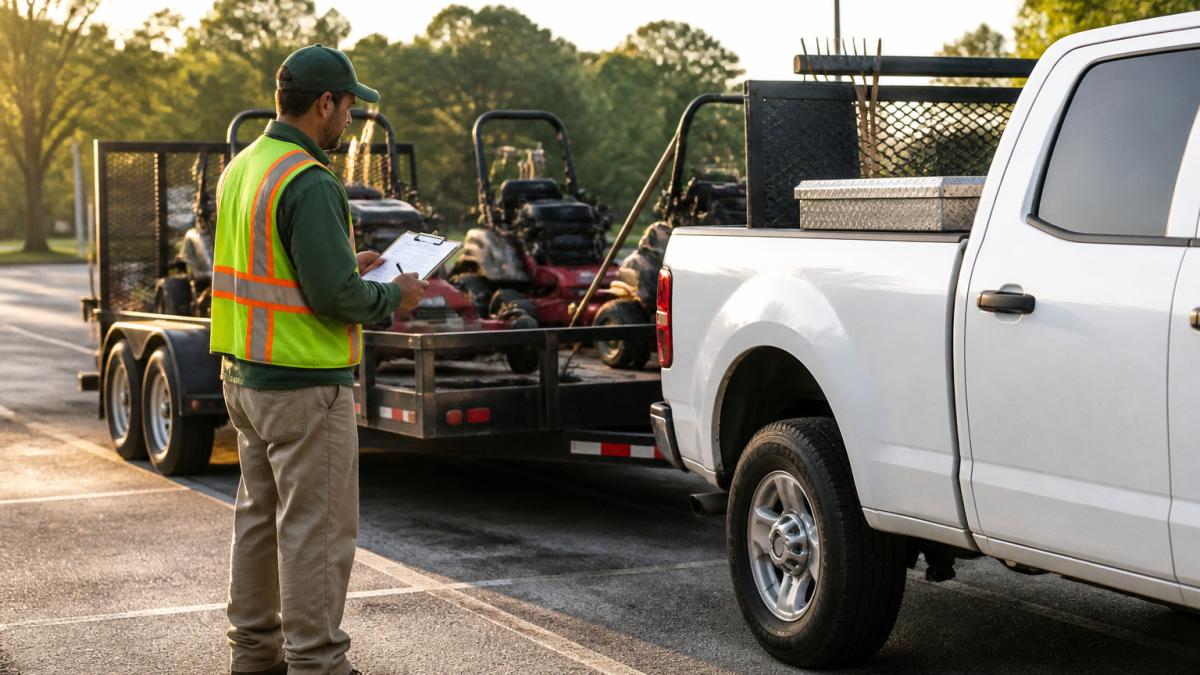
A landscaping vehicle safety checklist is a written, repeatable inspection every driver completes before a vehicle leaves the yard. It turns risk management into a daily habit and creates a documented record if a claim is disputed, proof the business had a system, the driver followed it, and the load was secured to a standard rather than to habit.
Run this before every shift, and keep the completed form for at least the length of your state’s statute of limitations for personal injury claims (commonly two to three years, but confirm your state’s rule):
- Walk around the truck and trailer; check tires, lights, and signals
- Confirm the hitch is locked and safety chains are crossed and attached
- Verify ramps are stowed and mowers are strapped at four points
Vehicle-Specific Hazards to Watch
Landscaping vehicles carry hazards most drivers never trained for: an unsecured mower blade or loose trimmer can become a projectile in a sudden stop, a trailer loaded beyond its rating fishtails on a curve, and debris blowing off a truck bed can strike a following vehicle.
Three hazards generate the most claims in this line of work:
- Trailer sway and fishtailing. Loading too much weight behind the trailer axle lightens the tongue and destabilizes the trailer at highway speed. Keep roughly 10 to 15 percent of the loaded trailer weight on the tongue, and never exceed the trailer’s gross vehicle weight rating (GVWR) or the tow vehicle’s rated towing capacity.
- Unsecured equipment. A walk-behind mower that is not strapped at four points can slide forward in a hard stop and strike the cab or a pedestrian. Straps should be rated for the load and inspected for fraying; a strap that has been cut or sun-damaged is a claim waiting to happen.
- Backing and blind spots. Landscape trucks and trailers have large rear blind zones, and backing into a customer’s parked car or a mailbox is one of the most common property damage claims in the trade. Require a spotter whenever a driver backs a trailer, and require the driver to walk the path before backing if no spotter is available.
Have every driver sign the completed checklist. A signed daily form is far more persuasive in a claim dispute than a policy manual that no one can prove was followed.
Driver Qualification File
The checklist covers the vehicle; the driver qualification file covers the person. Insurers and defense counsel expect a landscaping business to produce, for each driver, a license copy, an MVR pulled at hire and at least annually, and a record of any suspension or moving violation. Keep these in the personnel file and pull driving privileges on any lapse until resolved, this documentation supports a negligent-entrustment defense if an employee causes a crash in a company truck.
Job-Site Traffic Controls
A surprising share of vehicle liability claims happen at low speed on private property, a truck rolling into a client’s garage door, a trailer clipping a parked car in a driveway, or a mower striking a vehicle in a shared lot. Simple controls reduce these: designate a parking and turnaround area on each job site, keep trucks off lawns unless the client approves in writing, use cones or a spotter near structures, and set the parking brake and chock the trailer whenever the crew leaves the vehicle.
Three hazards generate the most vehicle liability claims in landscaping, and each has a straightforward control.
| Hazard | Cause | Fix |
|---|---|---|
| Trailer sway and fishtailing | Too much weight behind the trailer axle lightens the tongue | Keep roughly 10 to 15 percent of loaded weight on the tongue |
| Unsecured equipment | Mower not strapped at four points can slide in a hard stop | Strap at four points with load-rated, inspected straps |
| Backing and blind spots | Large rear blind zones on trucks and trailers | Require a spotter, or walk the path before backing |
What to Do After a Vehicle Accident: A Step-by-Step Response
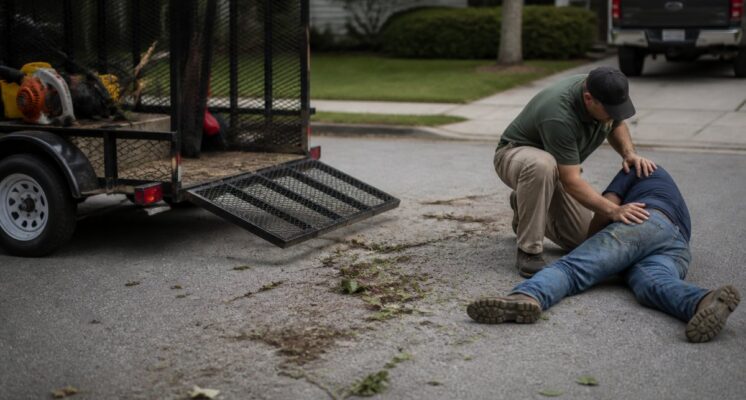
After a vehicle accident, the first priority is safety and the second is documentation. What you do in the first hour shapes how the claim resolves, sometimes more than the facts of the accident itself. The sequence below is written for a landscaping business whose driver is often an employee and whose vehicle is often loaded with equipment and towing a trailer.
- Stop, secure the scene, and check for injuries. Turn on hazards, set out triangles if you have them, and call emergency services if anyone is hurt. Move vehicles out of travel lanes only if safe.
- Do not admit fault, and do not speculate about the load. Be cooperative and factual with police and the other driver, but leave fault to the insurers and investigators. Avoid statements like “the trailer always fishtails” or “that strap has been loose for weeks”, they become evidence.
- Document everything before anything is moved. Photograph all vehicles, the load, the hitch and safety chains, the road, signage, and any property damage from multiple angles. Collect names, phone numbers, and insurance details from every driver and witness. Preserve dashcam or phone video the same day; many systems overwrite footage within days.
- Preserve the vehicle and equipment. Do not repair the truck, trailer, or damaged equipment until your insurer has inspected it or authorized repairs. Repairing or discarding parts beforehand can be treated as spoliation of evidence and jeopardize coverage.
- Notify your broker and your carrier promptly, and in writing. Late reporting is one of the most common reasons a claim runs into trouble. Report to your agent the same day, follow up with the carrier’s claims line as directed by your policy, and keep a copy of every notice.
- Notify your own team on a need-to-know basis. Your crew lead and office manager should know the same day so the paper trail stays consistent, but instruct employees not to discuss the accident with the other driver, witnesses, or anyone representing the other side.
- Route all communication with the other party through your insurer. Forward any call, letter, or demand from the other driver, their attorney, or a repair shop to your claims adjuster and do not respond directly, direct communication is how businesses inadvertently create admissions.
- Preserve the driver qualification file and the day’s checklist. Pull the driver’s MVR, license copy, and the signed pre-shift inspection form and give them to your insurer if requested. These records are your best defense against a negligent-entrustment or negligent-maintenance claim.
Do not let a crew member post about the accident on social media, and do not post photos of the scene from a company account. Posts and photos are discoverable and are routinely used to impeach a business’s account of events.
If the Accident Involves a Subcontractor or a Personal Vehicle
The response changes when the driver is not your employee. If a subcontractor’s driver is involved, notify your insurer immediately and provide the subcontractor’s certificate of insurance and additional-insured endorsement. If an employee was driving a personal vehicle on company business, notify your carrier under the hired and non-owned auto coverage and confirm in writing that the claim is being handled under that coverage rather than denied as a personal-vehicle loss, early confirmation prevents the gap between two policies from becoming a gap in your defense.
What to Hand Your Insurer
A complete first notice of loss shortens the claim and reduces the chance of a coverage dispute. Gather the police report number, photos, witness contacts, the driver’s statement, the pre-shift checklist, the driver qualification file, and the vehicle and trailer registration and maintenance records. If a trailer was involved, include hitch and safety-chain photos and the trailer’s GVWR sticker. The more you provide in the first 48 hours, the faster the carrier can evaluate coverage.
Coordinating Coverage: General Liability, Umbrella, and Exclusions
General liability and commercial auto cover different things, and the gap between them is where landscaping businesses get hurt.
Excess liability or umbrella coverage sits above both policies and responds when a claim exceeds your underlying limits. If a serious injury claim blows past your auto liability limit, an umbrella is what stands between your business and a personal judgment.
To see how these layers interact and where the gaps tend to appear, read our comparison of commercial auto vs umbrella liability insurance. If you carry several policies across vehicles, property, and operations, coordinating multiple insurance policies is the process that surfaces those gaps before a loss does.
Get a Vehicle Liability Review from Galt Insurance
Most landscaping businesses do not discover a coverage gap until a claim exposes it. The better path is a deliberate review: confirm what your commercial auto policy actually covers, add hired and non-owned coverage where missing, tighten driver screening, and layer an umbrella over the whole structure.
We provide tailored insurance solutions, manage your insurance profile in one place, and offer a dedicated team for a unified experience. If you are weighing whether the coverage is worth the premium, our discussion of whether commercial auto insurance for landscapers is worth it walks through the tradeoffs.
Frequently Asked Questions
Does general liability insurance cover accidents involving a landscaping company vehicle?
Usually not. General liability responds to third-party bodily injury and property damage at your premises or job site, but most policies exclude injuries or damage arising from the use of a company vehicle on public roads. That exposure belongs to commercial auto insurance. A landscaping business that relies only on general liability can face a serious coverage gap after a crash, so confirm your policy language and add commercial auto before a claim happens.
Can a landscaping business be held liable if an employee causes a vehicle accident?
Yes. Under vicarious liability, a company can be held responsible for the actions of employees acting within the scope of their job. If a crew member runs a red light in a company truck while driving to a job site, the injured party can sue both the driver and the business. Employee driver screening, written driving rules, and commercial auto coverage all reduce that exposure and show a court you managed the risk.
Does commercial auto insurance cover employees who drive their own vehicles for work?
A standard commercial auto policy covers vehicles the business owns, leases, or hires. When employees use personal trucks or cars for work errands, hired and non-owned auto insurance fills that gap. It responds when a personal vehicle used for business causes injury or property damage. Without it, your business could be exposed even though the vehicle belongs to the employee.
What should a landscaping business do after a vehicle accident?
Stop, check for injuries, and call 911 if anyone is hurt. Exchange information with the other driver, photograph the scene and damage, and collect witness names. Do not admit fault or discuss settlement. Report the accident to your insurer promptly and keep every document, including the police report and repair estimates. Notify your broker at Galt Insurance so the claim is documented correctly from the first day.
The challenge is not finding an insurance policy. It is confirming the one you have will actually respond when a company truck is involved in an accident. Galt Insurance can review your current coverage, identify the gaps between your auto, general liability, and umbrella policies, and build a structure that fits how your crews actually operate. Get started with Galt Insurance and protect the business you have built, one policy at a time.
